
Meaningful Musical Emphasis
In contrast to the singer or pianist, the string player must create consistent tone using bow movement that (in terms of force) is naturally uneven. The player who lacks systematic training does not understand this. Their performance consequently suffers—and they are unaware of it—because of the peculiarities of cello mechanics.
For example, a motive such as this one:
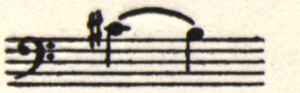
can sound dynamically different depending on whether we begin it on a down-bow or up-bow stroke. But we should realize that it’s not the bow arm, but our aesthetic awareness that should decide whether this little motive sounds like this:
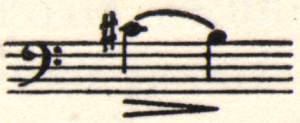
or like this:
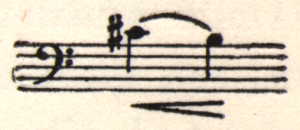
The interpretation should be completely independent of the bow direction. Correctly understanding this will protect the player from many mistakes, and especially from illogical “false accents”—that is, unintentional emphases on weak beats. If the player is allowed to drift carelessly through phrases, they will easily fall into the trap of interpreting a theme like this one from the second movement of Boccherini’s Sonata in A major in this way:[1]

instead of this way:

It hardly seems believable that some famous cellists actually present the main theme of the first movement of the Dvořák Concerto—unintentionally!—like this:

A succinct interpretation of this theme can only be achieved by correctly emphasizing the strong beats. On the first note, the emphasis happens without much effort, since it begins on a down-bow at the frog, meaning that it’s easy to execute. The half note, however, begins at the tip, and this makes it fall flat because the player doesn’t bother to emphasize is as much as the first note. In further problematic transgressions, there often follows an aesthetically unjustifiable but technically easier involuntary crescendo on the up-bow. (“Here’s a good opportunity! I’ll give it my all!”) A better execution of the theme would be to approach it in the following manner, assuming one doesn’t want to avoid any dynamic changes whatsoever:

- Becker's note: "In jazz, this would be a characteristic, stimulating means of expression, but in this particular example the emphasis is faulty." ↵