
On Musical Performance
“La musica è la figurazione dell’invisibile.” – Lionardo [sic][1]
The quality of an artistic performance is determined by how closely it approaches the artistic ideal. Since important principles for musical performance—both general and specific—are only revealed through compositional analysis of a musical work, it’s clear that an artistically outstanding performance can only be achieved through a synthesis of emotional and intellectual elements.
Someone may possess a beautiful, sonorous tone or great facility, yet still be unable to do complete justice to a Bach fugue or a Beethoven sonata. This requires the art of phrasing, the understanding of how to synthesize related musical elements. The inner strength to shape the significant moments through powerful means, and to forgo flashy effects during unimportant passages, must come to the aid of one’s imagination.
On the other hand, a musician may possess a deep understanding of musical syntax, and may also interpret music well, yet cannot interest the listener for any length of time, since they lack liveliness of feeling or the gift of a blossoming, soulful tone. First and foremost, all music-making is a sensual process. The path to the heart leads through the gate of the senses.
Musical aesthetics is a matter of general significance and validity. There is no special cello-oriented aesthetics. The phrasing of the good cellist should be the same as that of the good singer, pianist, or conductor. A perfect performance is based, here as elsewhere, on affect, alongside adherence to the same fundamental laws of rhythm, dynamics, and agogics. Only the technique and the degree of difficulty are different. And in this respect, we can indeed speak of an aesthetic of cello playing, since the technique all too easily and often unconsciously influences the performance. This must be investigated in detail in order to avoid the danger of a perception distorted by mechanical effects.
Ultimately, the conception of a sonata relies on the same artistic viewpoints as that of a symphony. That the conductor may be able to impose their will on an orchestra composed of many people is less of an artistic characteristic and more of a human one. However, like any instrument, the cello has a limited range of expression. Nevertheless, it is necessary that one’s own abilities be developed to the limits of possibility, and within these limits achieve the highest intensity of expression. In view of this moral duty towards works of art, what should one say about the opinion of certain cellists who declare a cello concerto with orchestra to be an absurdity? Quite aside from the fact that works like Beethoven’s Triple Concerto and Brahms’s Double Concerto would also fall under this verdict, one would have to accuse all composers of cello concertos, from Haydn to Hindemith, of poor judgment! Is these cellists’ inability to master anything beyond salon works the reason for such false conclusions?
In general, one can distinguish two categories of instrumentalists without passing judgment. Some are guided primarily by the simple pleasure of sound, letting the tones they produce work like objective listeners, inspired as if by the magic of sound itself. Psychologically, these people are blessed with intensive consciousness of tone, experiencing everything sonic as primary. When they combine this with musical education and taste, they belong to the type of those fortunate artists (e.g. Sarasate) who generally acquire public favor more quickly than musicians of the other category, who primarily work out a musical compositions intellectually (Joachim). The latter category tend above all to research the meaning and significance of a piece. Their pleasure in reproducing it in performance is conditioned less by the sonic aspect than by the expressive value of the music itself. As long as a lively, warm-blooded feeling is part of this, they form a valuable part of the artistic community.
To the first type belong more subjectively-oriented artists, who regard an artwork merely as an occasion for displaying their own musical experience. The second type feel compelled to serve as intermediaries between the composer’s work and the audience. This noble mission demands abnegation of the ego and renunciation of the cheap laurels of the virtuoso. Only moral responsibility toward art enables one to rise above oneself, to earn the right to leadership. The aspiring musician, who in music more than in other art forms is influenced by ideals of artistic perfection and dignity, often undergoes a change under the pressure of practical experience, so that ultimately everyone gravitates toward what comes naturally to them. This kind of aptitude inevitably crystallizes over time as a natural characteristic. Musical education also has its limits. The success of a pedagogue depends essentially on the material they have to work with, i.e. quality of their students (which is why it is so difficult to judge the value of anyone’s teaching methods based on the achievements of their individual students).
Schopenhauer’s saying applies to art as it does in life: “Fate shuffles the cards and we all play.”[2]
The educator has no influence on this mixture of fate. The inheritance of a certain amount of talent is a given. For talent to develop both musically and technically, it requires a rational method that makes it possibly not only to “play correctly,” but also to interpret music according to the highest artistic principles. This seems to us to be the true task of pedagogy.
As a purely instructional matter, we can present the way to cultivate and perfect the formation of tone quite methodically. Since the dynamism and form of movement are now clarified by empirical observation and scientific analysis, there remains no doubt about how to apply scientifically verifiable concepts to cello playing at several important points.
I. A general knowledge, gained through comparison with visual arts:
Great paintings and etchings work by bringing out what matters most—using color and line to emphasize the essential elements while pushing less important details into the background. The physiognomy of a musical work can likewise be determined through the medium of performance by emphasizing the essential and de-emphasizing the secondary. What creates light and shadow in visual art is also what creates rhythmic differentiation, dynamic gradation, and soulful expression in music (vibrato, portamento, agogics, etc.). For example, this dominant pedal from Bach’s Prelude in D minor:[3]

We can extend the comparison with visual arts even further: sometimes the goal isn’t to create striking contrasts, but rather to use mediating transitions that soften the tensions that might otherwise create sharp contrasts, for example in second measure of the penultimate system of the same Bach Prelude:

This measure provides balance between the previous intense buildup and the imminent resumption of the old tempo.
II. Increases, whether in speed or power, must develop logically:
For example, in the Prelude to the Reger Suite:[4]
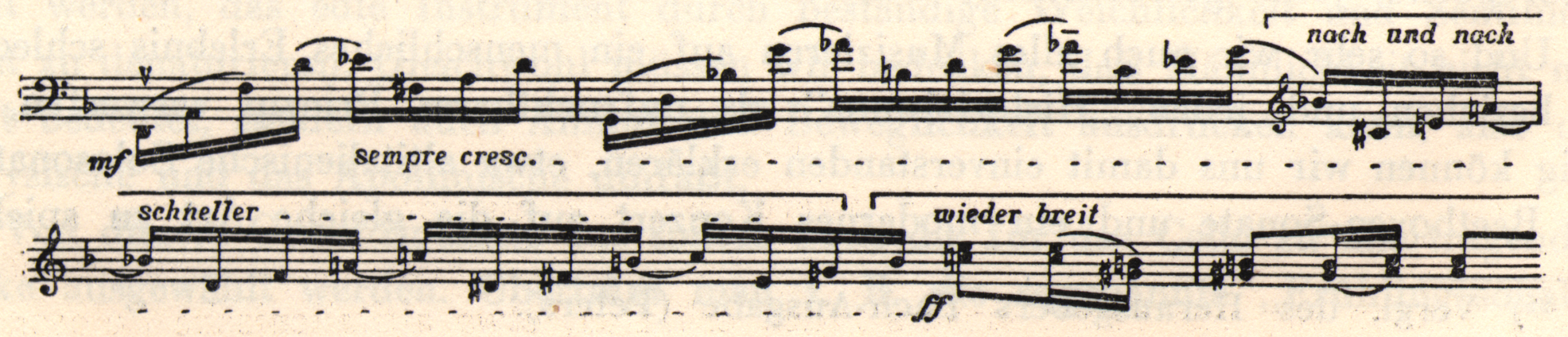
The player must determine in advance: where are the climactic parts of the piece? They must understand how to pace the buildup to a climax, otherwise the listener cannot understand the logical structure of the piece. (See my performance analysis of the Saint-Saëns Concerto.)
III. Characterization within a piece of music:
Music is not always so completely “absolute” as the sworn opponents of “program music” might claim. If we disregard for now the strictest compositional forms of classical music, where structure and development are grounded inherently in their own laws (e.g. fugue), then the cello literature also contains many works that demand concrete poetic interpretation. So many performers deprive themselves by simply “playing through,” unable to read the poetic meaning between the lines! The Bach Suites alone contain the full range of human emotions from seriousness and melancholy to radiant cheerfulness and exuberant joy in all possible transformations of spiritual states and lived experience. How impoverished are those performers who leave no room for imagination and focus only on formal structure! Equally limiting are those who take a one-sided approach—perhaps gravitating toward excessive seriousness, as often happens today. Even hypermodern musicians fall into this trap when they approach Bach with misplaced reverence, treating him as merely “historical.”
In most works, one or more secondary voices appear alongside the main voice, sometimes resembling dialogues; in others, there is only a single voice, for example in the Gigue of Bach’s Suite in E-flat major, whose character bubbles with life.[5] In some pieces, the outline or drawing is most important—essentially the overall shape of the movement. In others, it’s the coloring that matters most. An interpreter’s artistic spirit is revealed by how well they recognize and subtly emphasize these different elements.
IV. Questions of style:
The concept of “style” is extremely ambiguous. We only talk about a particular style once it belongs to history. While an art form is still fighting for acceptance in its own time, it remains problematic and controversial. As long as it’s trying to win over contemporary audiences, it faces either acceptance or rejection as a living, evolving form.
Only after a historical period has ended can we understand its connections—how the times influenced artists and how they responded to their world. No art, not even the greatest, exists outside of time. Every cultural period and historical age leaves its mark on the art it produces.
And as much as we may relate all music-making to human experience and reject every “historicism” as a sterile principle, we can hardly reconcile ourselves to playing, say, an old Italian solo sonata, a Beethoven sonata, and a modern concerto in the same manner.
V. The influence of personality on performance:
How can we distinguish the individual masters in the visual arts from one another when they work with identical materials and in the same style? The fact that the painter achieves something that cannot be expressed through careful analysis of composition, color treatment, or working methods—this is precisely what stamps the personality of a significant musical interpreter onto the work being performed (provided they are not suffering from a lack of disposition at the time). Among pianists, one can easily distinguish the particular quality of touch; among string players, the manner of tone production. Beyond this, differences can be established that affect not only the sensually perceptible process, but also extend to the spiritual content of the performance.
VI. Cello-specific characteristics:
The physical characteristics of the cello simultaneously determine its expressive capabilities. Compared to the violin, the deeper register and wider fingerboard give it a character more similar to a man’s vocal range. While it cannot achieve the same heights as a coloratura instrument like the flute or violin, the cello’s large tonal range (encompassing more than all the registers of all human voice types) enables it to express the lyrical element above all, and then to meet extensive technical demands as well.
The favorable hand position for bowing could enable the cellist to achieve even greater feats of bow technique than the violinist, if they understood how to exploit all possibilities without restraint. However, the violinist has an advantage over the cellist because the left hand’s finger technique operates within a much smaller area. But this disadvantage is somewhat offset by the cellist’s thumb being used to stop the string, which enables so many technical combinations that would otherwise be impossible.
Regarding sensual expression, the essential character of the cello comprises a baritone timbre within a defined tonal range. The greater the cellist’s skill, the more confidently they can move within these boundaries. It’s worth noting—and this is what matters when it comes to beauty of movement—that it must also be possible to reproduce the timbre of other voice registers, as well as that of most other orchestral instruments, to some extent on the cello, in order to “instrumentalize” them.
If we consider the cello’s expressive capacity from the spiritual side, the instrument’s developmental history already suggests its mission (see the previous essay on the evolution of cello playing): it was created as the voice of mature human experience. It is therefore sufficiently suited to express strength through appropriate softness and sentimentality. However, we must remember that the cello’s voice expresses not only passionate intensity, but grace and agility—thus encompassing both the Dionysian and the Apollonian.
We should use this perspective when selecting pieces to transcribe for the cello. For example, if we were to transcribe Beethoven’s “Spring” Sonata for the cello, the work’s characteristic jubilant quality would go missing, and it would seem to be almost a work of pathos. On the other hand, the Locatelli Sonata, which was originally for violin, is perfect suited for transcription.
However, the cello’s domain is undoubtedly the sustained and lyrical, and it will remain so. It is, par excellence, a songful instrument.
The artistic demand for tonal unification between the registers affects not only the determination of bow position but also the choice of fingering. As we discussed earlier in the section concerned with the mechanics of left-hand technique, “musical-aesthetic” fingering differs from the purely mechanical approach—sometimes we must sacrifice technical efficiency for the sake of musical intention. Such deviations, however, must be sufficiently motivated by artistic necessity.
We will compile examples of such techniques under the concept of “artistic freedoms.”
- Becker paraphrases a quote from Leonardo da Vinci's Trattato della pittura. The original is "Se la pittura è la definizione delle cose corporee, la musica è la figurazione delle cose invisibili" ("If painting is the definition of corporeal things, music is the figuration of invisible things"). ↵
- “Das Schicksal mischt die Karten, und wir spielen.” Arthur Schopenhauer, Parerga und Paralipomena (1851). ↵
- Becker's annotations in the music example use the terms bedeutend (significant) and minder bedeutend (less significant). ↵
- This excerpt is from Reger's Suite No. 2 in D minor. Translation of Becker's annotations: noch und noch schneller, "faster and faster"; wieder breit "broadly again". ↵
- Becker's note: "See the present author's edition of Bach (Peters)." ↵