
On the Meaning of Slurs in String Literature, Particularly for the Cello
There is often a diametrical opposition between the demands of musical expression on one hand, and those of mechanics on the other. From a general musical standpoint, as we know, the slur marking (i.e. the ligature) indicates phrasing.
In notation for keyboard or string instruments, however, the ligature sign has yet another meaning: for the former it also indicates legato, for the latter it determines the bow change.
Since we are not dealing with the keyboard here, let us just say: it is obvious that the demands of phrasing do not always coincide with the necessity of a bow change. Consequently, there is some confusion in this area. The problem can only be controlled if the string player develops their bowing technique to a level of perfection that allows him to proceed solely according to artistic principles, free from mechanical constraints.
The prerequisite for this is, however, knowledge of the musical-aesthetic principles that, despite their universal validity, are nonetheless usually ignored. As a good example for the correct understanding (or, rather, juxtaposition) of phrasing and bowing, take the beginning of the Allemande from Bach’s G major Suite. The note groups marked with brackets show the “punctuation” of the phrase versus the slur markings, which determine bow direction:

As we can see, two legitimate demands stand side by side, demanding logical agreement.
A player who is less trained, or not trained at all in musical-aesthetic principles might now ask why bow changes are not always arranged in the manner the expression demands.
Those with little or no musical-aesthetic knowledge might now reasonably ask why bow changes are not always arranged as the expression demands.
The answer is first for reasons of dynamics, and second because of the expression and character of the sound.
The portrayal of strength and energy naturally requires more frequent bow changes than a passage of tenderness and melting sweetness. But even if we had sufficient strength to effectively play, for example, the opening of the Allemande with the following bowing:
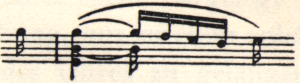
…we would nevertheless prefer the previous solution for the sake of an energetic and decisive performance. It should also be noted that it corresponds to the manuscript considered the original (housed in the Berlin State Library).[1]
Even more striking, perhaps, is an example that demands a broad, solemn singing style at a slow tempo. Let us consider the Sarabande from Bach’s Suite No. 4 in E-flat major:

Regardless of frequent bow changes, the melodic flow should continue uninterrupted with even beauty and fullness of tone, and only pause for a moment at those places where “punctuation” makes it musically necessary.
The skilled singer acts according to the same principle, though the nature of their “mechanics” means that they cannot perform a breath change as imperceptibly as a first-class string player can perform a bow change. However, they are unconditionally required to do so. Thus, a principle emerges that is equivalent to an axiom: bow changes have nothing to do with phrasing in an artistic sense, but they can effectively support it.
- Becker refers to the manuscript of Bach's Cello Suites in the hand of Anna Magdalena Bach, which was (and still is) housed at the Staatsbibliothek zu Berlin. ↵