
Playing Chords
The ability to play chords (i.e. sounding of three or four strings at once) is one of the key criteria for judging a cellist’s bow technique. It is no exaggeration to state that only a few cellists are capable of playing chords at a forte dynamic and with a beautiful, resonant tone without arpeggiating them. Aside from siding ugly and scratching, chords almost always come out like the first of these examples below, instead of like the second.[1]
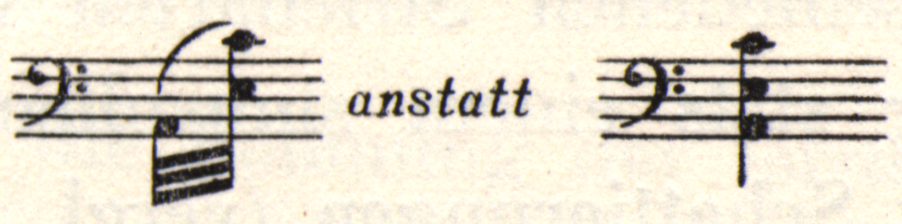
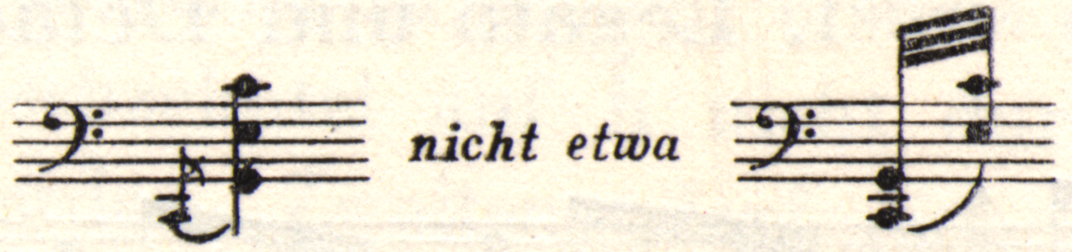
The situation is even worse with four-note chords. Playing all four strings simultaneously is impossible (you would need an instrument with a very low string height and a barely rounded bridge, which would not be advisable for several reasons). Therefore, if we are to create the impression of four notes that sound simultaneously, we should play the bass note as an extremely short grace note, then play the remaining pitches without arpeggiating them. This should sound like the first example below, not the second.
How should we proceed to achieve maximum sonority when bowing a three-note chord (without doubling the root of the chord)? We place the bow on the string a few finger-widths from the frog, with all the bow’s hair on the middle string (see image 67 of the Appendix). The exact place you choose to do this depends on the curvature of the bridge, since the bow should also touch both adjacent strings through appropriate index finger pressure. If the bridge of the cello is so strongly curved that the strings are far away from one another, the sounding point should be closer to the fingerboard. With flatter bridges, it should be closer to the bridge itself.
To avoid scratching noises, one should aim for precisely perpendicular contact between bow and string. Use intense, energetic arm movement, and avoid excessive finger pressure on the stick of the bow. Here, the wrist and elbow joints must be “passive” and almost motionless. The bow grip differs from normal because the bow is not acting as a movable lever with a string as a pivot point. Rather, it has to glide across a surface and overcome the resulting friction.
- Becker's note: Of course, there are also cases in which an arpeggiated chord is musically well-founded. ↵