
The Nature of Vibrato
There are widely differing views on the nature of vibrato. Without examining these more closely, let us ask the question: “What is the purpose of vibrato?” and answer it: “The soulful animation of sound.”
Just as the human voice reveals our inner emotional involvement in any experience through its natural vibration—whether we are experiencing heavenly joy or mortal grief—in this way, we bring our tone to life through vibrato.
Clearly, the well-known controversy, “slow vibrato or fast?” is a moot point, since both types are good if they correspond to the expression indicated by the composer.[1]
The intensity and speed of the vibrato should therefore only be determined and applied in accordance with the respective affect. Any sensitive person will probably have to admit, upon closer consideration, that the rapid, lascivious, so-called “coffee-house vibrato” cannot be the appropriate means for portraying deep, noble feelings, although we cannot do without it, albeit in a refined form, when it comes to letting Eros speak!
We would never be content with only forte and piano for dynamics, but rather should apply every available shading in between; by the same token, we should never content ourselves with a single type of vibrato. Every emotional aspect of making music demands a different mixture of power, color, and expression; the choice of vibrato character plays a big role. But so often, the cellist errs in this respect… The tendency to play any cantilena with overflowing feeling is widespread. Hence Hanslick’s[2] calling the cello the instrument of melancholy and sentimentality. But unjustified, overblown sentiment comes across as ridiculous because it creates too much expression. Just as a drunk cannot see a full glass without emptying it, so the cellist seems unable to perform any cantilena without becoming sentimental. Does only a mournful voice awaken our desire to sing? I venture to suggest that joy often motivates us to sing more than pain. The human voice is, indeed, a model for us… The singer is protected from such mistakes by the underlying text of the music, but the cellist lacks such a guide and therefore often makes mistakes in which means of expression to use.[3] How misguided it is to play the second theme in the first movement of Haydn’s D major Concerto with a lamenting, mournful character… One should deliver it with joyful radiance, like a lark singing as it soars toward the sun! It is exactly so, too, in the C major variation of Tchaikovsky’s Variations on a Rococo Theme. C major is not suited to lamentation! This excess of expression has already brought many a composer close to despair. Busoni[4] criticizes the “vibrating excess of the cello” and counts it among the phenomena that hinder the free flight of the composer’s imagination. How right he is! When the deepest pain no longer has tears, having in a sense turned to stone, then the depiction of this state can only be achieved through the complete absence of vibrato. An example of a passage demanding such restraint is the transition to the fugue at the end of Beethoven’s Sonata in D major, Op. 102. Here, painful numbness alternates with the expression of deep anguish.
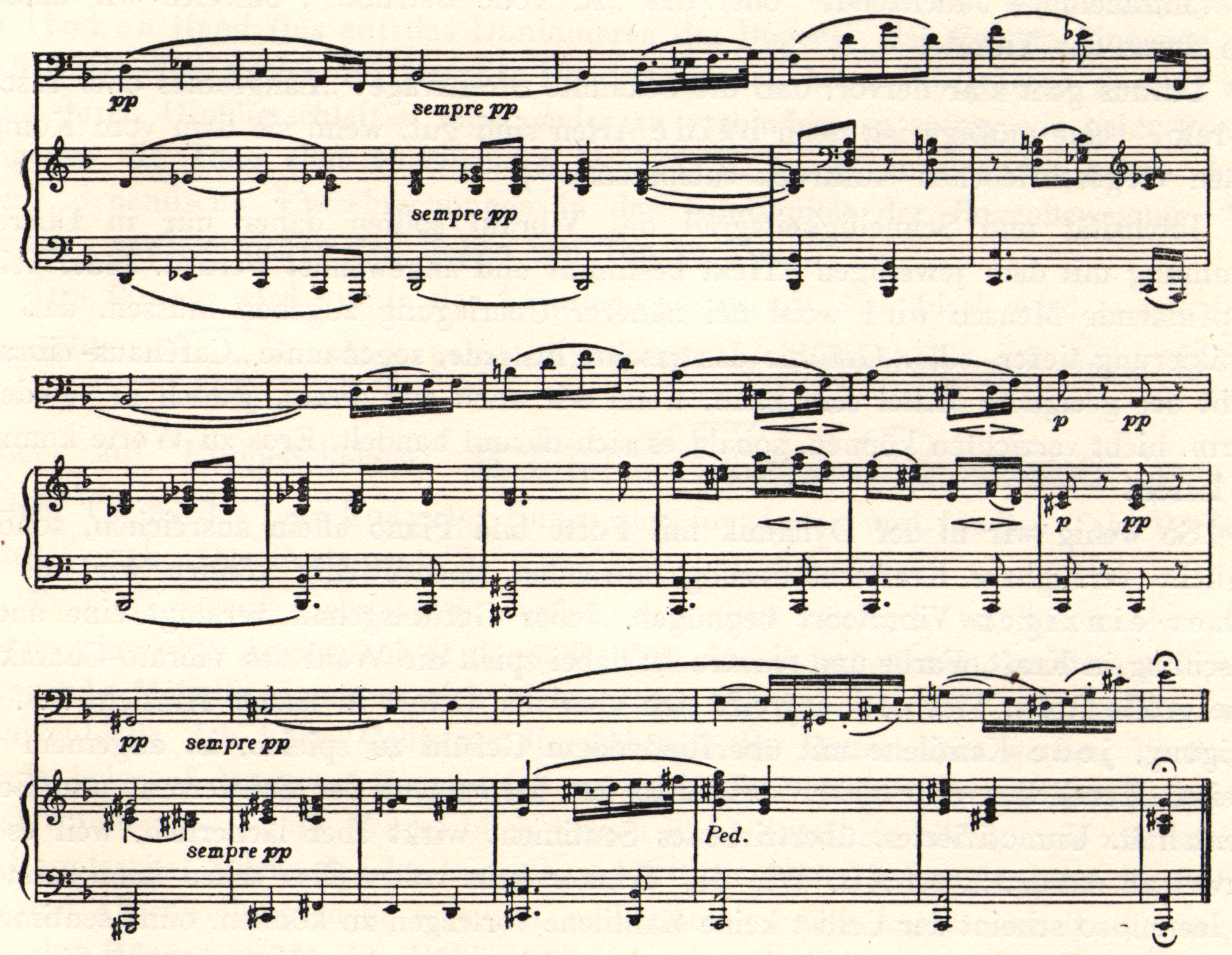
The passage quoted here should therefore be played as follows: the first three and a half measures without vibrato, then gradually increased vibration until the climax at F at the beginning of the sixth bar. In the second half of this measure, the vibration decreases until the expression is completely still. The same is repeated in the following measures, with the difference that the decrease in vibrato now extends over several measures (10, 11, 12) and is completely absent from the thirteenth measure until the end.
With such an approach, one can completely achieve the mood desired by the composer. The tension thus reaches an almost oppressively high level, only to find release with the entry of the fugue subject of the next movement.[5]
When it comes to the performance of Bach, we should also only apply vibrato discreetly. But how do things stand with this in the present day? The precious, mannered Bach playing of some hypersensitive cellists is often unbearable to listen to. Serious classical music does not tolerate the “erotic vibrato.” It demands dignity, nobility, and grandeur, without losing any warmth. It is a sign of weakness in a performing artist when their expressive means are exhausted by vibrato. Perhaps it would be worth considering how this state of excessive vibrato playing arose.
Without a doubt, it is something to do with the times and the fashion. No coffee-house, no high-end restaurant today believes it can do without an “ensemble.” The unenviable musicians who participate in it, among whom there are undoubtedly often talented people with respectable skills, are forced to adapt their performances to the level of their audience. This cannot, of course, be of a musically superior quality. Music only plays a secondary role in such settings; it is offered as a background for eating, drinking, and entertainment. If the musicians did not add strong “spices” to their performances, they would hardly be able to make themselves heard amidst this witches’ sabbath of noises caused by coming and going, loud talking, serving, etc. They have to, as the saying goes, “lay it on thick” to make themselves heard. The light music offered in such places mostly does no further harm. But when artists who are supposed to serve pure art transfer this “style” to the concert hall and use its exaggerated affects on musically valuable pieces, it is practically immoral.
Initially, the coffee-house imitated the concert hall by offering so-called “artist concerts”; today, many concert artists imitate the coffee-house style! To prevent misunderstandings, I would like expressly to emphasize that this deductions do not contain anything derogatory towards the coffee-house musician. In coffee-house ensembles one encounters artists who would pass with honor in any serious concert, and in the concert hall one hears performances that would not be sufficient in many a coffee-house ensemble.
Through slower or faster vibrato, we can meaningfully support the character of a musical piece, as noted above. The same applies to individual phrases. In a melody consisting of a certain number of notes, for example, not all of them are of equal importance. The more important harmonic notes, which usually fall on the strong beats of the measure, require a more intense vibrato than the others for beauty and clarity of presentation. The vibrato emphasizes them more and, so to speak, illuminates them. This substantially supports good phrasing.[6]
It is difficult to determine when vibrato became established. What is certain is that the old classical schools in Italy and France were averse to the extensive use of vibrato. The only student of Paganini, Sivori (1815-1894),[7] who had a wonderful tone,[8] did not use vibrato at all. Alfredo Piatti, the greatest cellist of Italian birth, used vibrato rarely and only very discreetly…
That vibrato may not have been common practice among violinists in Paris in the early 1830s is evident from a critique by the French music writer F. I. Fétis[9] in the Revue musicale (1831, no. 6) after Paganini’s first appearance in Paris. He writes: “A completely new and unique effect is the trembling vibrato of the string that he uses to ‘sing.’ This closely resembles the human voice, especially on the three lower strings. Unfortunately, this is often accompanied by a slipping movement of the hand, which one might compare to the drawing-out of notes in human singing, which some rightly fault in singers and consider tasteless.”[10]
It’s not unnecessary to ask why the excessively sensitive vibrato style is so popular today. The answer does not seem difficult: it is easier to indulge than to rise to the sublime. However, the artist who strives to constantly cater to the feelings of the masses in his art ultimately loses the ability either to express the sublime or to forego cheap effects.
- Becker's note: "Knowledge of the 'doctrine of the affects' would protect players from such mistakes." ↵
- The Austrian music critic Eduard Hanslick (1825-1904), a musical conservative and champion of Brahms. ↵
- Becker's note: "Carl Ludwig Schleich [1959-1922, a German surgeon and philosopher] writes in The Wisdom of Joy [Die Weisheit der Freude und andere ausgewählte Schriften, 1920]: 'The origin of music is laughter. It was not labor that created song, but the rhythm and breath of the jubilant affirmation of life created the intervals; notes are the voices of joy. The fact that suffering also found expression in notes does not contradict the joyful nature of music. Laughter, too, has tears and can be painful.'" ↵
- The Italian composer Ferruccio Busoni (1866-1924). ↵
- Becker's note: "I would like to take this opportunity to mention a performance of the "Eroica" under S. v. Hausegger [Siegmund von Hausegger (1872-1948), an Austrian conductor who worked variously with the orchestras of Frankfurt, Berlin, Hamburg, and Munich], which became an unforgettable experience for me thanks to the moving, truly exhausting rendition of the funeral march. I attribute a large part of the profound, lasting impression to the fact that the funeral march theme was performed by the strings without any vibrato. The effect was shattering..." ↵
- Becker's note: "Naturally, there are also exceptions to this rule." ↵
- The Italian violinist Ernesto Camillo Sivori (1817-1894), the only known student of Paganini. Sivori was a long-standing trio colleague of Becker's teacher Alfredo Piatti (1822-1901). ↵
- Becker's note: "The Nestor [a reference to a wise elder statesman in Homer's Iliad] of today's violinists, my long-time quartet comrade Hugo Heermann, even described Sivori's tone as the most beautiful he had ever heard." ↵
- François-Joseph Fétis (1784-1871), the Belgian musicologist and critic whose Biographie universelle des musiciens remains one of the most important sources for research in nineteenth-century music. ↵
- Becker's note: "Fétis, who could be proven wrong about newer developments, here confuses two things that have no organic connection. However, it is clear from his remark that Paganini, whether consciously or unconsciously, must have made rich use of the effect. The fact that in certain (moving) passages in glissando upper positions, the vibrato of the strings is indicated by [a waving line], proves that it was only occasionally applied as a special effect. (Cf. Jos. Joachim-Moser Violin School [Violinschule, authored by Joseph Joachim and edited by Andreas Moser, published by Simrock in 1905].)" ↵